
In a scattered working world, we need to focus more than ever on relationships
I have a twenty-year old piece of paper. On it, my Dad set out advice for me as a new manager. He wrote:
- “You should be known to everyone who works with you.
- Make sure you know what’s going on. Get out and talk to people – it’s called ‘walking the job’.
- Make it satisfying for you and everyone else. The work is its own reward.”
In my first management roles, I would go round every desk and every office to find out how people are, what they were doing and what they needed from me to thrive at work.
I felt connected.
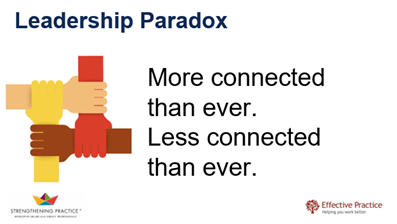
My colleague, Jo Fox, has identified the paradox of modern leadership: We are more connected than ever but we feel less connected than ever.
Technology allows us to reach more people than ever before but we can feel more isolated than ever. We are scattered, distant, often separated by screens. We are fragmented in our communication, and often text-based so there is no serve and return. We frequently interact with AI agents and machines.
The digital world brings fantastic opportunities. However, the pace of change is pushing us beyond our learned ability about how to create a sense of collaboration and shared culture.
In this context, we need relational, human-centred leadership more than ever. McKinsey’s 2026 report on the State of Organizations states that critical ‘human skills’ such as emotional intelligence and judgement will become increasingly valuable. And that a ‘human-centric’ approach to leading organisations is needed.

So what does human-centric leadership look like?
Well, we think it looks like relational leadership. And that social workers have a lot to offer in this area.
For a long time, social work has advocated for relational approaches over impersonal processes, arguing that experience matters as well as result. And, in fact, that the outcome is often compromised by lack of relationship.
Our social work ethics and capabilities are tuned to empowering people through human-to-human encounters that enable insight, learning and positive change.
Evidence points to the limits of our technological and scattered context. Shared purpose, collaboration, critical thinking and creativity are fostered by human encounters. Social work’s emphasis on in-person and embodied practice, reflective supervision, peer support and role modelling are tried and tested methods of building a human-centred organisation. They enable people to thrive and they engender motivation and the desire to stay.
They also require people to take a lead. Jo and I want to contribute to leaders’ relational confidence to do this. We want to help sustain human leadership. And we want to grow discernment about what is needed for the human. There are so many tools at our disposal to connect. We need to develop wisdom about how best to use them.

We are planning a course on Relational-leadership in a Digital World.
We will draw on evidence and bring people together to discuss, reflect and grow their agency as leaders.
If you think this could be useful to you, please get in touch.