
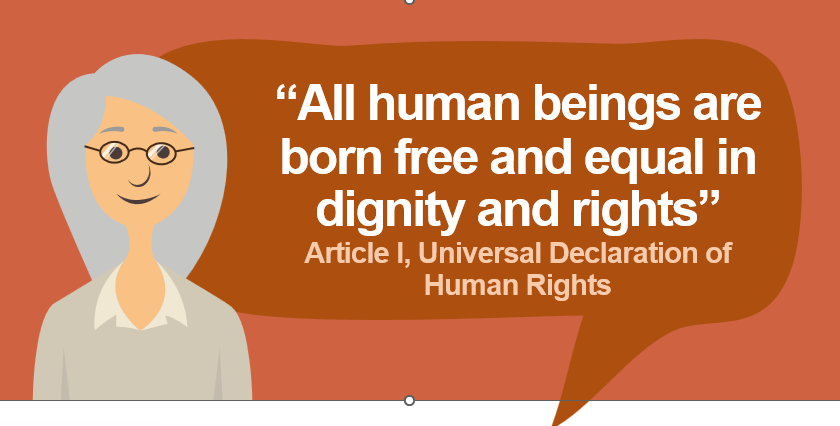
The 1948 Universal Declaration of Human Rights says that all humans are born equal in dignity and rights. The endeavour is to live up to that at every stage of life. In older age, this has to include a commitment to being anti-ageist.
Human rights are universal. However, in later life, rights are often undermined due to three specific issues:
- Firstly and overwhelmingly, due to ageism. The common reduction of our complex humanity to a stereotype or assumption based on age undermines people’s opportunities, options and outcomes.
- Secondly, due to the way ageism interacts with other forms of discrimination and ensures that the impacts of these deepen and worsen.
- And finally, because humans in later life encounter many changes – physical, financial, relational, cognitive – that create a complex set of potential barriers to them being able to uphold their rights.
In later life, we all might face these barriers and may experience being reduced to a label. We need a robust and specific response to this.
We need a human rights response that is deliberately anti-ageist.
This means:
- Seeing older people as fully human with the same dignity and scope as anyone else
- Having positive expectations about later life
- Holding the person’s voice, wishes and decisions central throughout the life-course
- Taking action so that older people receive their legal entitlements and remain in control of what happens in their lives.
In the United Nations there is currently work underway to create a binding convention about older people’s human rights. This is in response to the fact that across the world older people don’t experience the same rights as younger adults.
In the UK, ageism shows itself in how we talk about older people and how we treat them. However, there are great anti-ageist initiatives too:
- Age Without Limits has an age-inclusive writing and communication guide
- The British Society of Gerentology is tackling ageism in social care
- There are calls for legal protections to tackle exclusion
- In social work, the professional body is advocating for access to a social worker when older people experience a major life-change
- And there is support for the UN’s work to create a convention.
Everyone can take a stance in their own life, family and community to uphold rights in later life.
This starts with our commitment to how we talk about older age. Then, to notice where older people’s voices and presence is missing from discussions and decisions. And to take practical steps to ensure everyone is able to stay in charge of their life throughout their life. This includes each of us:
- Writing down our wishes
- Ensuring that people we trust know what those wishes are and can advocate with us
- Setting up a power of attorney so that someone we trust can make a decision for us if we cannot do this ourselves.
Whilst we fight for equal rights globally, let’s also take action at home.